The quiet invoice: getting paid on time without chasing anyone
Late payments are rarely about the client being difficult. They are about the invoice arriving at the wrong moment, in the wrong shape, with nothing attached to it that explains why it exists. Here is a sequence that fixes it.

For a lot of studios, “getting paid” is a ritual. Finish a project, feel relieved, wait a polite number of days, then open a spreadsheet, build an invoice from a template you half-trust, export it, attach it to an email and press send. Then wait again. Then write the awkward follow-up. Then, sometimes, a second one.
The clients are not villains. Most of them pay eventually, and most of them mean to pay on time. The trouble is that the invoice itself does almost nothing to help them. It shows up as a surprise, it references nothing they recognize, and it asks for an action they have to remember to take. Every one of those is fixable, and none of the fixes involve being pushier.
An invoice should never be the first time money is mentioned
The single biggest improvement is moving the money conversation earlier. The proposal states the total, the deposit, the milestone schedule and the day each invoice will land. The contract repeats it. By the time the first invoice arrives, the client has already agreed to that exact number on that exact date twice. There is nothing to approve, only something to pay.
This sounds obvious written down. In practice it means the proposal is where the payment plan is designed, not the invoice, just as it is where scope creep is stopped before it starts. If a client pushes back on a deposit, you want to find out while you are still deciding whether to take the work.
Send it the moment the milestone closes
Batching invoices at the end of the month feels tidy. It is tidy for you and terrible for cash flow. A milestone finished on the 3rd is invoiced on the 30th, then paid on net-30 terms a month after that. Two months of float, created by habit.
Instead, send the invoice the same day the milestone is accepted, while the work is still fresh and the client is still pleased with it. Enthusiasm has a short shelf life, and an invoice that arrives inside that window gets paid faster than one that arrives after the next problem has surfaced.
Nobody pays an invoice because it is overdue. They pay it because it is in front of them, it makes sense, and paying it takes less effort than putting it off.
Make the invoice explain itself
The most common reason an invoice stalls inside a client company is that the person who receives it is not the person who commissioned the work. It lands with a bookkeeper who has never heard of you, with a line item that says “design work” and a number that could be anything. So they park it and ask a question, and the question takes a week to be answered.
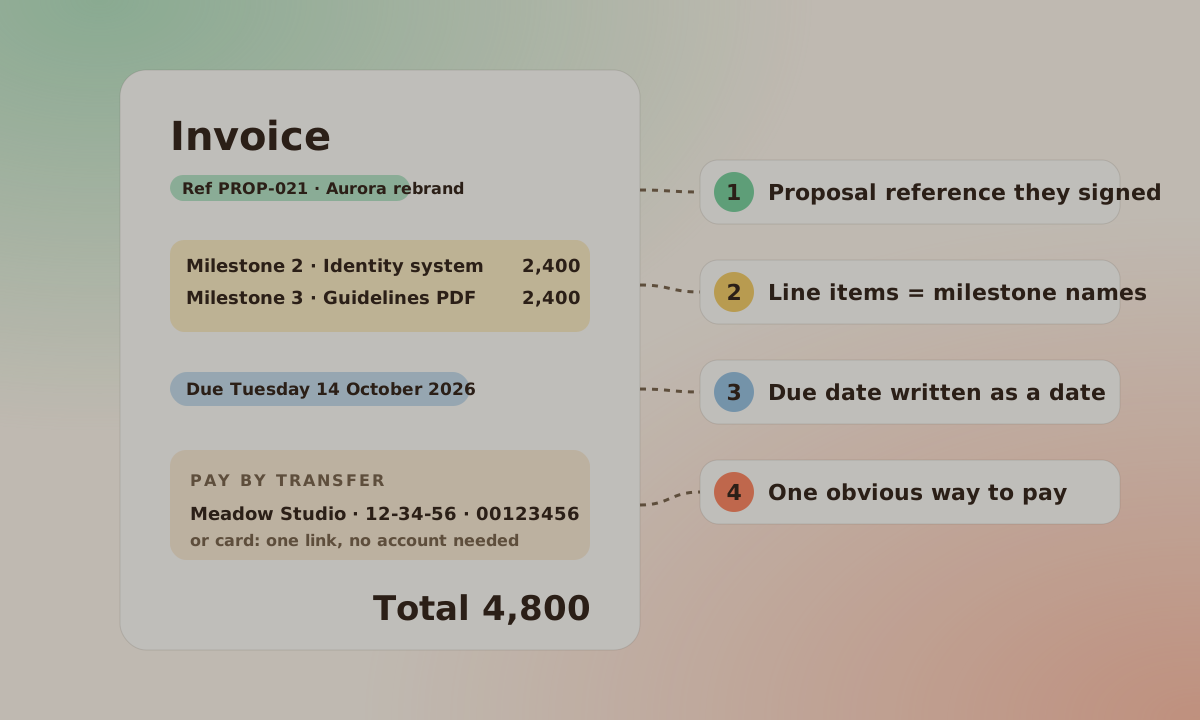
A good invoice carries everything that person needs to approve it without asking anyone, whether you build it in an app or in a free invoice generator:
- The project name and the client-side contact who signed it off.
- The proposal or contract reference the amount comes from.
- Line items that match the milestone names the client already knows.
- The due date written as a date, not as “net 30”.
- One obvious way to pay, with the account details or a payment link right there.
Reminders should be boring and automatic
The follow-up email is the part most people dread, so it gets written badly and sent late. The fix is to stop writing it. A reminder goes out three days before the due date, one on the due date, and one a week after, each from a template that is polite, short and identical every time. Because they are automatic, nobody on your side has to feel awkward, and because they are consistent, clients learn that the dates mean something. If your terms include a late fee, the late fee calculator shows what an overdue invoice has earned and gives you a fair clause to quote.
Subject: Invoice INV-0042 is due on Tuesday

Hi Dana,

A quick note that invoice INV-0042 (Milestone 2, Identity system)
is due on Tuesday 14 October. The PDF and a payment link are attached.

If it has already gone out, thank you. No need to reply.

PriyaWhat changes
Run this sequence for a few months and the biggest change is not the speed. It is that you stop thinking about it. Invoicing becomes a thing that happens at the end of a milestone, the way a handshake happens at the end of a meeting. That is the real goal. Not faster payment for its own sake, but a studio where money is settled quietly in the background so you can keep your attention on the work.
Was this useful?
Meadow Desk
Notes from the desk
Meadow Desk is a calm workspace for freelancers and small studios: clients, proposals, tracked time and invoices in one place. We write here about the parts of studio work the desk touches: proposals and pricing, scope, tracked time, invoices and the clients behind them.
More notes from the desk
The best free tools for freelancers in 2026
A practical list of free tools for freelancers: pricing, proposals, contracts, invoicing, time tracking, scheduling and taxes, with what each free plan covers.
Scope creep starts in the proposal: writing one that protects the project
Every “small extra” a client asks for mid-project was already possible on the day you sent the proposal. The document just failed to say no in advance. This is how to structure a proposal so the boundaries are agreed before the work begins.
What a week of honest time tracking shows about your margins
A project can look profitable because the invoices get paid. Track every hour for one week, including the ones you would rather not see, and the picture changes.